Sunday, January 3, 2016
Saturday, June 26, 2010
Sarah Does Stanislaus
I was in the Central Valley and couldn’t resist, and so traveled to this town of 70,000 to observe the goings on. I had hoped to talk to those who paid $500 per ticket and ask them what the attraction was. I am honestly curious.
But I couldn’t get within a half mile of these people. A and A Temporary Fencing had been contracted to erect a barrier around the periphery of CSU Stanislaus. All I could do was peer through the metal diamonds. Police were everywhere. Who paid for all of this? The LA Times reports unnamed sources saying that Palin was paid $75,000 plus expenses for her visit. It also reports that the CSU Stanislaus Foundation, a private off-shoot of the school, which invited Palin, says it “grossed more than $450,000 in cash and in-kind donations, for a net cash total of $200,000.”
I am innumerate so welcome challenges to my math, but the tickets cost $500 and 375 were reportedly sold, for a total of $187,500. Palin’s fee was $75,000 plus expenses. And then there was the meal. And the bill from A & A Temporary Fencing. And they had better have paid the Turlock police and CSU security guards for their time. So what, exactly, was left? The president of CSU Stanislaus said that a third of this left-over money will be used for scholarships and the rest will fund university programs. But exactly how much is that after all this security is deducted? At what price was a public university placed off limits to the public, from 10 a.m to 11:30 p.m., on Friday June 25, 2010?
This is the Palin visit where intrepid students dumpster dove to find remnants of a contract that demanded plenty of water and bendable straws. According to the LA Times, Palin derisively said during her 40-minute speech: “"Glad I got some of those contractual demands out of the way.” First of all, that joke was worth about $1,875 if it’s true that she was paid $75,000 (which works out to $1,875 per minute). Second, she twisted without denying her contract, making a joke of the students who had outted her while blithely skipping over the main point, which is her obscene demands. At the end of the day, what is most disturbing is the image of that chain-link fence around a public university. How did this happen? How is this okay?
Friday, June 18, 2010
Drilling Down Part V
This evening, NYT columnist David Brooks does an end run around the facts when talking to the NewsHour’s Jim Lehrer. In a case of Joe Barton lite, Brooks accuses President Obama of strong-arming BP to set up an escrow account for those affected by the Gulf oil spill. Here is Brooks' less-than-eloquent argument:
“We have a set of laws, when somebody does something bad, does something negligent, to force them to pay and compensate those who were damaged. And that's all on the books. And what President Obama did when he very publicly and very brutally strong-armed BP into setting aside this $20 billion, is, he went around those laws.””
What laws would those be? He’s certainly not referring to Chapter 11 of the US Bankruptcy Code, which allows corporations to declare bankruptcy as a way to avoid environmental liabilities. This ploy has been used repeatedly to shirk responsibility for cleaning up toxic messes. Some analysts argue that BP couldn’t circumvent its obligation to pay claims against it, but the fact is that bankruptcy has been the go-to strategy for companies that want to foot drag, obfuscate, and avoid paying the full amount for the damages they have caused. It's the American way, and all this talk about "strong arming," "shakedowns," and "slush funds" could not be further from facts on the ground when it comes to what's going on with BP and the US government. It's actually the first serious effort I've seen to avoid a legal loophole that's been allowing corporate criminals to get off the hook for years.
In 2006, I wrote an article called “Going for Broke,” and nothing has changed since then. The story focused on a mining company called Asarco, but Chapter 11 is a friend to all polluters, including BP. Here’s the key point:
“Reorganization under the Bankruptcy Code's Chapter 11 helps companies wipe the slate clean of environmental liabilities, giving them a fresh start. In the United States--a country that has based its keystone environmental laws on the principle that polluters, not taxpayers, should pay to clean up the poisons they spew--Asarco is just one example of how corporations use Chapter 11 to slough off massive environmental liabilities, reorganize, and then emerge leaner and meaner to operate another day.”
This oil spill is the worst environmental disaster in US history. In addition to seizing the moment to make real headway on climate change and a clean-tech economy, we might also take this opportunity to close the obscene bankruptcy loophole.
Sunday, June 6, 2010
Drilling Down Part IV
Orange Crate & Barrel bag; Uni-ball pen; notebook cover; Nikes; grocery store vegetable bags; the orange and gray seats on the Muni train; [the electricity to run the Muni comes from coal, natural gas, and a miniscule amount of renewables]; Muni flooring; the retractable curtain between Muni cars; the pavement on my street; Patagonia Polar fleece jacket; Blackberry; Sony television; Bose radio; MasterCard; Canon camera; salt and pepper shaker; landline telephone; three-ring binder; Rolodex; stapler; Brother fax machine; Apple MacBook Pro; mixing bowl; serving spoon; watering can and hose; extension cord; clothes hamper; waste basket; tooth brush; Invisaline braces.
I’m sure there was much more I missed. The list began when I tried to situate myself in the Gulf of Mexico oil spill. What moral responsibility do I have for this cataclysm? Clearly, I’m implicated. Distressing. But equally so was the NPR story this morning on how Americans can detach completely their gas guzzling ways from the mess in the Gulf. The reporter asked: "Do you feel any connection or responsibility as you gas up your car for this horrible thing that you're watching on the news?" The unanimous answer? "No."
Come on. We're all polluters. The amazing thing is that we can't seem to bring ourselves to acknowledge this, but instead remain steadfast in our rage and blame aimed at BP and the feds. Forget sustainability. What ever happened to that conservative cornerstone of personal responsibility?
Thursday, June 3, 2010
Drilling Down Part III
Wednesday, June 2, 2010
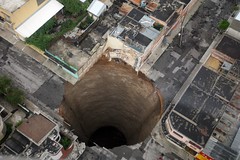
Hundimiento Means Giant Sinkhole
Drilling Down Part II
What is wrong with Tony Hayward, BP’s CEO? Today he denies the existence of masses of oil plumes in the Gulf of Mexico: "The oil is on the surface. There aren't any plumes," he told AP. This kind of magical thinking has been on display before.
A month after the April 20 explosion on the Deepwater Horizon oil rig, he told Sky News that "I think the environmental impact of this disaster is likely to have been very, very modest.” He went on to say that BP’s cleanup efforts would be a “textbook example of how to do an emergency response.” Hundreds of thousands of gallons of spilled oil later, reality has apparently tapped Mr. Hayward on the shoulder. His response? “I’d like my life back.”
It’s easy to beat up on poor Tony. It’s harder to grab hold of the slime he’s spewing and wrestle it to earth. There have been two massive undersea plumes discovered so far, the most recent a 22-mile-long mass snaking its way toward an underwater canyon that will lead it directly to Florida’s coast.
As to the degree of environmental impact? To date, approximately 715,000 gallons of total dispersant have been deployed—630,000 on the surface and 85,000 subsea. According to toxicology expert Dr. William Sawyer, the dispersants being used in the cleanup effort—Corexit 9500 and Corexit EC9527A, both also known as ‘deodorized kerosene’—have the potential to cause just as much, if not more, harm to the environment and the humans coming into contact with it than the oil possibly would if left untreated. "With respect to marine toxicity and potential human health risks, studies of kerosene exposures strongly indicate potential health risks to volunteers, workers, sea turtles, dolphins, breathing reptiles and all species which need to surface for air exchanges, as well as birds and all other mammals," he said. Dr. Sawyer made these comments before the Gulf Oil Disaster Recovery Group, which represents the United Fishermen's Association and the Louisiana Environmental Action Network, among others. Not to worry. According to Tony Hayward, the nine cleanup workers who have been hospitalized so far had food poisoning, not toxic exposure.
As to the oil itself, we still don’t know exactly how much crude oil is gushing each day from the well, but it has been adjusted upward from BP’s insistence on 5,000 gallons per day to between 14,000 and 19,000 gallons. Crude contains Volatile Organic Compounds benzene, toluene, ethylbenzene, xylene and naphthalene. These VOCs have potential acute toxicity to aquatic life in the water column. For humans, chronic effects include changes in the liver and harmful effects on the kidneys, heart, lungs, and nervous system. Benzene is a known carcinogen. Fun times.